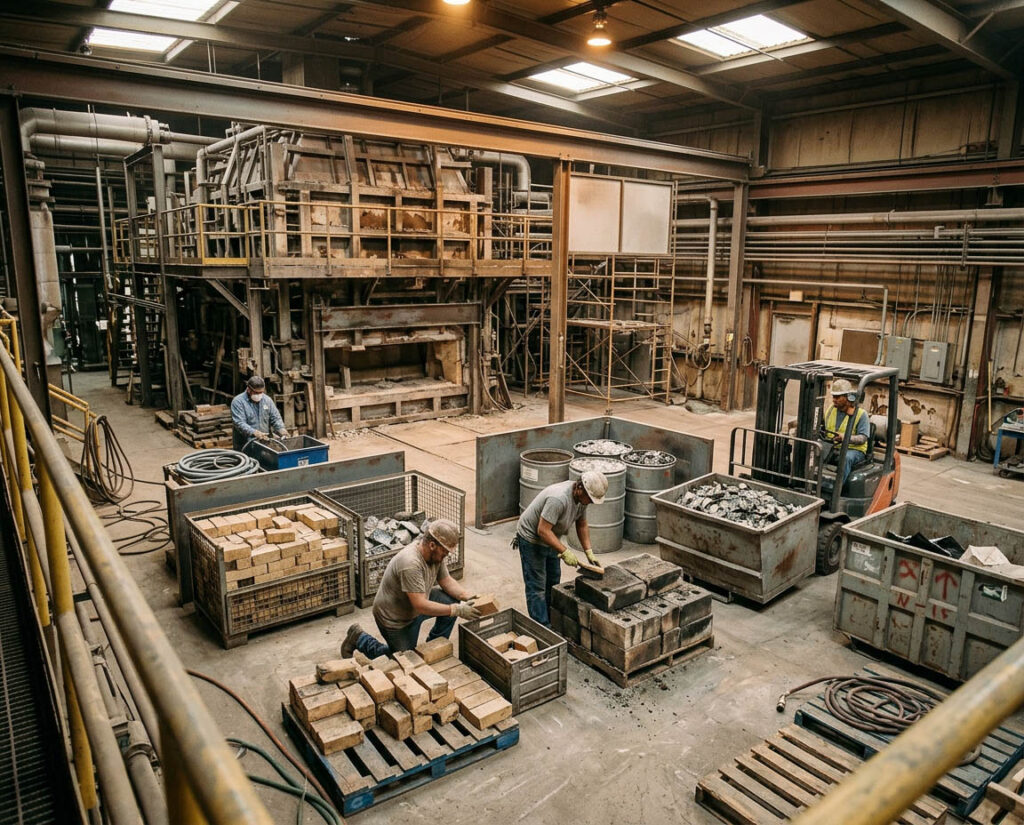
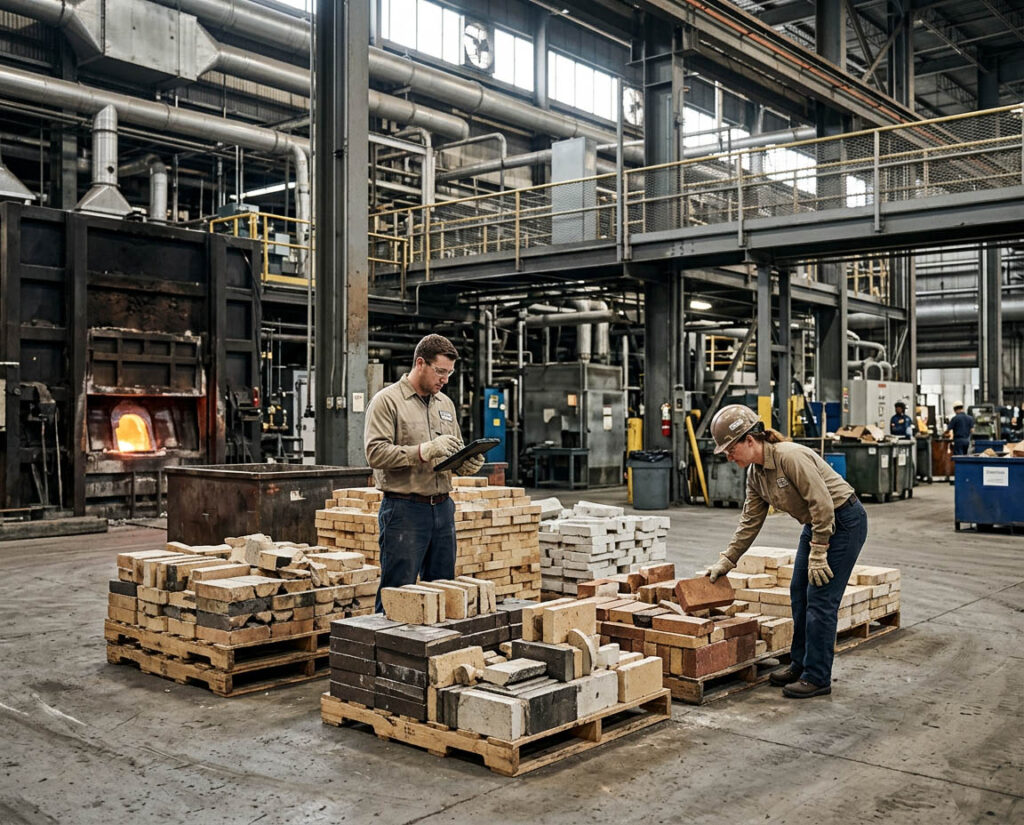
Most furnace rebuild teams understand that removed refractory carries regulatory and environmental considerations. What is less commonly understood is that certain materials installed in every glass-producing furnace are naturally radioactive — and that this can create serious complications at the landfill if it is not anticipated and managed before demolition begins.
That material is NORM: Naturally Occurring Radioactive Material.
What NORM is and where it comes from
NORM is not the product of any industrial process. It is not created by heat, chemical reaction, or anything that happens inside a glass furnace. It is a characteristic of certain raw materials mined from deep within the earth that carry trace levels of naturally occurring radionuclides — primarily uranium, thorium, and their decay products — as part of their geological composition.
In glass manufacturing, the primary source of NORM refractory is zirconia-based material. Products such as AZS (alumina-zirconia-silica), dense zircon brick, and similar fusion-cast refractories are widely used because of their exceptional corrosion resistance and durability at the melt line. Those properties come from zirconium compounds that, by their nature, carry trace quantities of uranium and thorium. The radioactivity is inherent to the mineral — not a consequence of any process the furnace performs.
How NORM migrates through a furnace
One reason NORM creates unexpected challenges during demolition is that it does not stay where it was originally installed. Over the operating life of a furnace, zirconia-based refractory at the melt line and in glass contact zones can deteriorate, spall, and shed material. Those fragments and fine particles migrate through the furnace system and accumulate in areas where no one would expect to find high-zirconia content.
The most common location is the regenerator checkerwork and the flue dust that settles below it. A furnace may be constructed with no intentional NORM refractory in the regenerator — but after years of operation, particles shed from the tank and superstructure work their way through the system and collect in the packing and flue dust below. That accumulation can register above background radiation levels on detection equipment, even though no one on the demolition crew knew it was present.
Why this creates a problem at the landfill
Modern landfill facilities use radiation detection equipment at their scales and tipping areas. These systems flag incoming loads and do not distinguish between hazardous artificial radioactivity and naturally occurring material. When a load carrying NORM refractory — even in small amounts mixed with otherwise routine demolition debris — triggers the alarm, the landfill will typically reject the load pending investigation.
A load rejection during a furnace outage is not a minor inconvenience. It creates schedule pressure, requires material to be held on-site or transported elsewhere, and raises compliance questions that take time to resolve. If the plant team was not aware NORM was present, the situation becomes significantly harder to manage quickly.
Regulatory context is not straightforward
NORM-containing refractory is federally exempt from NRC licensing requirements when uranium and thorium content is below 0.05 percent — which covers essentially all standard glass furnace refractory. But federal exemption does not close the regulatory loop. State and local governments have enacted their own regulations governing NORM disposal, and those requirements vary considerably by jurisdiction. Some states require characterization prior to disposal. Others impose landfill notification requirements. A facility that assumes federal exemption resolves all compliance questions is likely to encounter a different answer.
The material safety data sheets for common NORM-containing refractories — including AZS, dense zircon brick, and similar products — explicitly note that disposal is the owner’s responsibility and recommend that a qualified environmental professional characterize the waste and confirm compliance before disposal proceeds.
On-site expertise changes the outcome
The difference between a load rejection and a smooth disposal process is almost always advance preparation. When experienced personnel are present during demolition, they can identify where NORM-containing material is likely to be found — including in locations where it was not intentionally installed. They can perform hand scanning to characterize suspect material streams, coordinate with the receiving facility before loads depart, and document the material appropriately to support the facility’s compliance record.
That kind of on-site oversight cannot be effectively applied after material has already been loaded and transported. It requires knowledge of furnace construction, operating history, and how zirconia-based refractory behaves over a full campaign. It requires someone who has worked through these situations before and knows where to look before a landfill alarm turns an outage into a logistics and compliance problem.
Closing thought
NORM in glass furnace refractory is not a rare edge case. It is a predictable consequence of how these furnaces are built and how they age. The question is not whether NORM material will be present during a demolition — it is whether the team managing that demolition is prepared to handle it correctly.
Proper identification, material characterization, advance coordination with disposal facilities, and regulatory compliance documentation require on-site expertise that understands both the material and the environment it operates in. Facilities that plan for NORM before demolition starts are far better positioned to avoid delays, protect their compliance record, and keep the outage on schedule.